Episode 04 · September 26, 2024
Labyrinths & Mazes
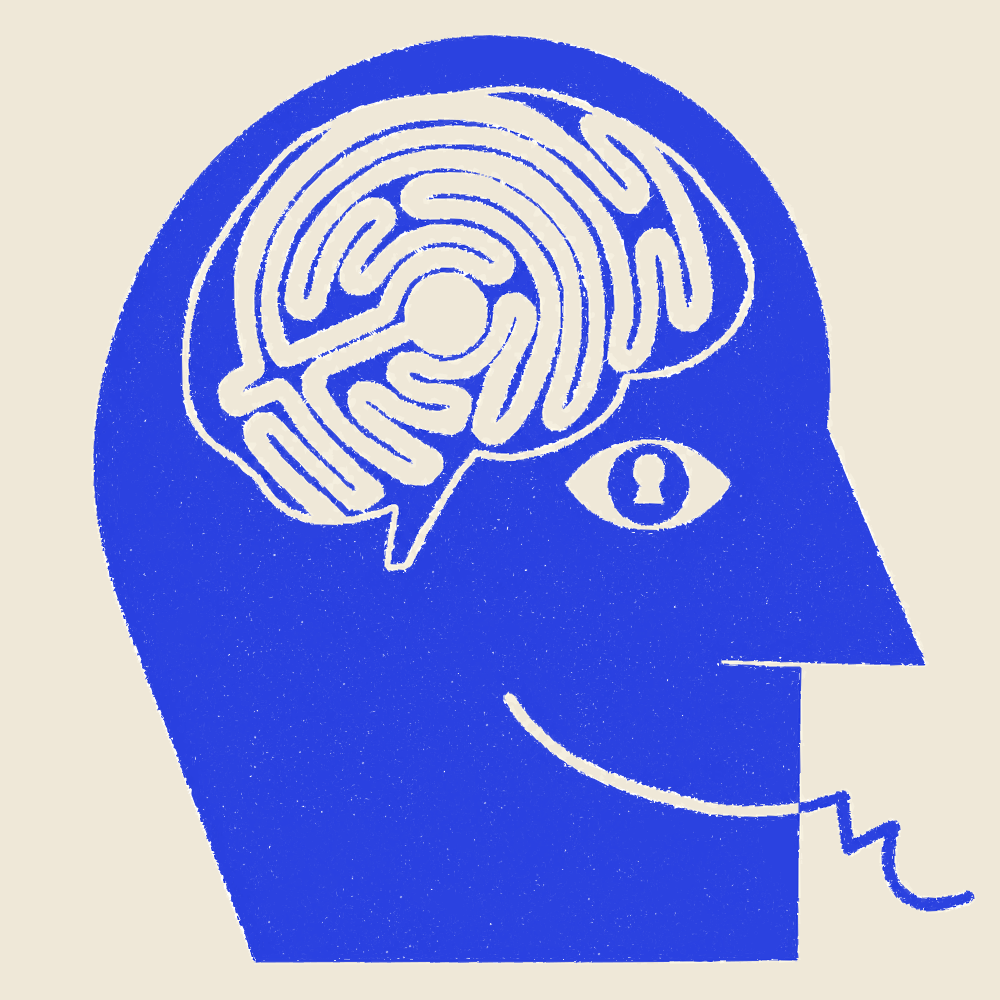
A journey through the labyrinth as myth, sacred architecture, literary device, psychoanalytic symbol, and metaphor for Autistic experience, told through monologue, play, poetry, and theory.
Listen to the episode
Press play.
Follow the thread.
The full audio essay is available here and on Spotify.
Open in Spotify ↗The written editionRead the episode script
About 57 minutes of reading · Chapters, citations & download
Guiding Framework
What
The central idea of this episode is that the labyrinth is one of humanity’s most enduring and generative symbols, a structure that has been used across myth, art, religion, psychology, and culture to model how human beings understand the mind, the world, and the relationship between the two. The labyrinth, in its vastness, complexity, and refusal of linearity, becomes both the human psyche and the world the psyche attempts to comprehend. Through this lens, the labyrinth also functions as a powerful metaphor for the internal worlds Autistic people inhabit.
Why
The reason for producing this episode is to trace the genealogy of the labyrinth as a symbol across art history, literature, philosophy, and mass media, and then to reclaim it as a living metaphor through personal mythology. By weaving together historical analysis, creative storytelling, and lived experience, this episode uses the labyrinth to articulate how meaning is constructed, how minds navigate complexity differently, and how Autistic ways of thinking, often misread as confusion or madness, can instead be understood as deep, systematic, and exploratory forms of sense-making.
Introduction
Hi and welcome to Matthew Mythology: Stories from An Autistic Art Historian. I’m your storyteller Matthew Mahoney.
Today, we are going to talk about the symbol of the Labyrinth. The Labyrinth is an enigmatic symbol with a long history from Greek mythology and Christian churches to acting as a metaphor in Renaissance/Mannerist, psychoanalytical, and postmodern/psychocentric contexts. I will talk about all these histories as well as utilize the symbol in monologue, play, poetry, and theory. This episode was rerecorded along with the other original episodes.
The genealogy of the Labyrinth as a symbol as is the case with any metaphor is important for us in helping grasp the world in poetic, beautiful, and reflective ways. I am hoping in this episode that you will be able to see how the labyrinth functions as a metaphor for the systematic, narrative-building, and powerful imagination of humanity; for constructed, encyclopedic bodies of knowledge; and for the structure of the Autistic psyche versus the non-Autistic or Allistic psyche.
Our very first stop in our journey is Ancient Greece.
1. Ancient Greece: The Labyrinth as Myth and Ideology
“Triumph of Theseus”, Monologue
Many people’s first reference to labyrinths is the infamous story of Theseus and the Minotaur. For those who don’t know this story, this is an important one in this journey.
To retell this story, I wrote a monologue from the perspective of Theseus. To set the scene, Theseus, after his murder of the Minotaur, is relaxing on a beach of the island of Naxos with his girlfriend Ariadne next to him and 7 men and 7 maidens huddled nearby, organized into couples. The people nearby are his audience. In the monologue, Theseus tries to justify his murders from murdering thieves outside Athens to murdering the Minotaur and the Minotaur’s father in the name of reason, in order to destroy what’s unreasonable and unnatural. He wants to tell this story now, so the Athenians know just how big a deal killing the Minotaur and other unnatural creatures is for the civilized part of the world including Athens. Here is the monologue:
To all that will listen to my story, listen closely. I have triumphed over the unnatural Minotaur and saved the Athenian men, part of our species, the rational man, and the Athenian women, who will propagate future rational men.
I, the embodiment of reason, have triumphed over insanity where others have failed. Sisyphus, driven and doomed to activity, does the same thing over and over again, expecting different results. He has descended into madness. Such men delude themselves as intelligent and better equipped to tolerate the chaos and complexity of the world.
I say we destroy the chaos and to this end, I have chosen the path of Zeus. Zeus brought order back to the cosmos when he murdered his father Saturn, a god who committed the injustice of devouring Zeus’ brothers and sisters. I chose to conquer and control, opening the land up for use by Athens and civilization. This quest to kill the minotaur given to me by the gods was an important task to achieve this.
For my efforts, the gods have blessed me with happiness in return. This happiness comes in the hand of my girl Ariadne, the one who helped me on my quest. I can’t wait to return to my birthright in Athens and see one of my fathers, King Aegeus, again. (Sigh of relief) And now, I can finally relax and tell you my story.
My mother Aethra, daughter of King Pittheus of Troezen, had me from mixed semen, partially from intercourse with one drunk mortal, King Aegeus, and partially from intercourse with one horny god, Poseidon.
As a little kid, my mother told me in order to prove my birthright, I had to become of a certain age, move a rock, and dig up my father’s sword and sandals. I did just that, and then left my mother to go on a journey to Athens where my mortal father lived and ruled.
For me, to get there, I had to go through many trials, killing things in my way. I killed Periphetes in Epidaurus and took his wooden club. I killed the despicable thief and murderer Sinis, using the method he used on his victims, tying their limbs between two great pine trees stretched to the ground and letting it go. I had sex with his daughter, hopefully bringing another rational man into the world. I slaughtered a giant pig called the Crommyonian Sow. I killed a robber named Sciron who forced travelers to wash his feet and then kicked them off a cliff to their deaths in the jaws of a giant sea monster. I wrestled King Cercyon of Eleusis to death. I decapitated Procrustes with an axe. I captured and sacrificed the Marathonian Bull. I tamed and conquered the chaos of the world and would not fall victim to insanity but… (sigh) I knew it wasn’t enough.
So, I finally arrived to Athens to meet my father. I kept my identity a secret because I knew a mysterious heir to the throne coming into town might cause trouble. His new wife Medea was a witch, and she immediately didn’t like me. This was confirmed when she tried to poison my wine which at that point, with my dad knowing who I was, got her divorced and exiled. Her children, the previous heirs, due to my father being supposedly childless, tried to overthrow my father and I killed them.
After these events, I served on my father’s court as Prince of Attica and Personal Advisor and Guard. It was on my father’s court that the gods showed me a real opportunity to prove myself and finally defeat the chaos, the evil, the insanity of the world. This quest was killing the unnatural offspring of the Marathonian Bull, dead thanks to me, and the fair Queen Pasiphae, the Minotaur, as you know my most recent justified killing, that embodiment of insanity and chaos, that spawn of Hell that is now dead, and saving you fine rational men and fair pretty maidens and the future of our civilization from his unsatisfiable appetite, destroying chaos instead of letting chaos consume and destroy our civilization.
My father, the king, didn’t want me to do this quest. In order for me to save you all, I reassured him that I would make the sails on my ship white on the way home to let him know I am alive. After y’all were thrown in the labyrinth, I arrived in the city on my ship, pretending to be on a diplomatic mission, and knew I had to act quickly. I could tell King Minos didn’t care much for me but being the son of the king of Athens, he was cordial and civil. (Looks affectionately towards the girl next to him) His daughter Ariadne, I become infatuated with, and to my later knowledge, she become infatuated with me. (Eskimo kiss; rubbing noses; smiles) She was so cute when she pretended to drop something so she could give me a secret message. She wrote a note saying to meet her at the entrance of the labyrinth that night.
With sword in hand, that night, when I met her, she told me that Athena had conversed with her and told her of my ambitions to kill the Minotaur. In her hand was a long thread and a candle and she told me that this thread and candle could be used to navigate the complex chaos of the labyrinth created by that other insane man Daedalus. I told her to wait on my ship while I finished my mission.
I put my sword in my sheath and as I entered, the moon become eclipsed and little light was around. From the entrance, I dropped the thread as I went through the zigs and the zags. When I was quite deep into the labyrinth, I started seeing you’ll, individually or in small groups, scared and trying to hide where there was nowhere to hide. When I entered the center, I heard snorting and grunting, which sounded like a bull but much louder. I knew I was close to the Minotaur. He was sleeping. With the candle, I was able to see his feet, then his legs, then his hips covered by a cloth, the one sign of civility in this terrible beast, then his chest, muscled but obviously not as muscled as mine, and finally his head, the hideous head of a bull, lying on a rock. I was in shock, such a being shouldn’t exist. I had to pinch myself to know I wasn’t dreaming such a sight. He started to stir due to the light. I knew I had to act fast. Before his eyes opened, I already was behind him, ready to slice his neck as he woke and lifted his head from the rock. When he woke, he tried to stab me with his horns as my hands around his neck wrestled to slice it. With a tiny slice in his neck, he broke free and repositioned himself so he could charge me. He charged and missed. He charged and missed. This is thanks to my great agility and speed. Thanks to the darkness, he didn’t see when I came for his head again. I went behind the beast, bewildered, wildly turning his neck, shifting his eyes, trying to find me, and in one quiet moment, sliced his head off, his last expression being one of surprise. I killed the insane beast and brought the world some peace and order. Even if it was dead, I was happy to see a bull’s head and a man’s body, two parts natural apart, apart from each other as they should be. As I exited, I found each one of you’ll and told you to follow me, and then we escaped on my ship.
This is my story. So, men, have sex with your women tonight, on this beautiful island, so we can serve civilization and expand it. And women, serve your purpose with good faith and a smile.
Analysis: Theseus, Classicism, and the Labyrinth
Throughout this monologue, Theseus presents himself as an egotistic, prideful, self-absorbed person who justifies his murders as curing the world of its diseases, making the world a better place. This is hypocritical as he has superstrength and other unnatural traits but somehow believes he is a good judge of what’s natural and not. There is also a theme of misogyny as he believes women are only important in procreation and just objects to be used sexually.
I wrote this monologue to tell the story of Theseus and the Minotaur but also as a creative introduction to the one of the concepts in which the labyrinth is used as a metaphor. Throughout this monologue, a contrast between reason and insanity is noticeable. Theseus keeps referring to the men as rational and parts of a rational civilization and refers to some other famous men like Sisyphus and Daedalus, the god Saturn, and creatures like the Minotaur as part of some evil, insane, uncivilized, wild other.
This contrast is the contrast that Gustav Rene Hocke in his seminal 1959 book “The World as a Labyrinth” makes between Classicists who emphasize classical harmony and Anti-Classicists or Mannerists who emphasize imaginative, creative insanity and chaos. This contrast was introduced lightly in the first part of “An Introduction to Surrealism & Modern Art”.
Hocke argued that Mannerists believed that the labyrinth represents the beautiful, intricate, albeit chaotic imagination, the dark but beautiful underbelly of the human mind. To Theseus, who I made as a great classicist in the monologue, sees the labyrinth as ugly, vile, and unnatural, as working against the order of the world. The thread and candle represent instruments to navigate the chaos and insanity of the labyrinth. The Cretan poet Epimenides in his telling of the story used a similar symbolism to the candle: a crown of glowing gems and gold given by Bacchus to Ariadne who then gave it to Theseus to navigate the dark labyrinth.[1]
This metaphor will be further explored after a summary of the Labyrinth’s Greek origins as well as a look at other historical contexts including Christian, Renaissance, and psychodynamic contexts. I learned much about Greek origins of the Labyrinth from W.H. Matthews’ survey of labyrinths “Mazes and Labyrinths: A General Account of their History and Developments.”
Labyrinths and Mazes: Terminology and Symbolic Equivalence
First off, I agree with W.H. Matthews’ understanding of labyrinths and the closely similar word mazes. Some argue that labyrinth refers to unicursal, meaning one path to the center and maze refers to multicursal, meaning multiple choices of path and direction, having dead ends. Matthews and I consider maze to be merely the northern equivalent of the word “labyrinth.” The distinction between labyrinth and maze seems unnecessary as both work in all the symbolisms and metaphors.[2]
Ancient Historians and Rationalized Origins of the Myth
The origins of the Greek myth of Theseus and the Minotaur is shrouded in mystery. Many Greek historians, born quite a while after the events of the myth, thought the story arose from exaggeration of historical details. Philochorus, an Athenian historian, believed the real story was the Labyrinth was a dungeon in Crete with Athenian youths, imprisoned for their country having killed Minos’ son, that were killed by a fully human executor as tributes in annual games dedicated to the death of that son.[3]
Aristotle believed that the Athenian youths were simply slaves, not people with death sentences by Minos. An account which is in agreement with Plutarch who believed the Greeks wrongfully made a great man, an embodiment of justice, King Minos, out to be this deplorable man who would sentence youth to be murdered by a bull-man hybrid monster.[4]
Minos and Daedalus as Titles Rather Than Individuals
Others questioned if Minos was a real historical figure and was rather simply a name bestowed on Cretan kings like Pharaoh for Egyptian kings or Caesar for Roman kings. This same line of questioning went towards the name Daedalus, the inventor of the labyrinth. It was thought the name may just refer to those who are inventors and engineers in Crete.[5]
Archaeology, Bull Worship, and the Minoan World
What is more interesting is 20th-century British archaeologist Sir Arthur Evans’ theory of the myth’s origin built from the excavation discoveries of 19th century German archaeologist Schliemann. In Schliemann’s excavations, in a grave, he found an ox-head of gold plate with a double axe between the upright horns. Bulls and double axes are frequent recurring symbols in Cretan artifacts as well as artifacts from other parts of Greece. In Labranda in Caria, to the northeast of Crete, the double axe was a symbol of Zeus in worship. These symbols had significance in Minoan worship and suggested a cult of the bull.[6]
Schliemann in excavations of Tiryns in 1884 found a grand mural depicting a man holding one horn of a great bull while he leapt over its back, the animal charging at full speed, and in excavations of the palace at Knossos found a grand mural depicting two girls dodging the charge of a bull while a boy let go of its horns and turned a somersault over its back. Both suggest the Minoans had a sport of bull-leaping most likely practiced within the palace grounds.[7]
The Palace of Knossos as the Historical Labyrinth
Dr. Evans concluded that the palace of Knossos was the Labyrinth, and the word Labyrinth refers to the “House of the Labrys” or “House of the Double Axe,” with the word “labrys” referring to a double axe, more specifically the double axe of Zeus used in worship by Labranda in Caria. In this palace, on the fallen plaster of one of the walls of a corridor, was a repeated meander pattern, painted in red on a white ground, very suggestive of a sort of maze. Dr. Evans said that a much later Cretan civilization probably discovered these vast and complicated ruins and, trying to understand its mysterious frescoes and enigmatic symbols, came up with the story of Theseus and the Minotaur.[8]
Mythmaking, Memory, and the Labyrinth as Psyche
The inventiveness of the myth of Theseus and the Minotaur represents the strong human imagination and psyche, which the Labyrinth itself is a symbol of.
2. Christian and Spiritual Labyrinth Metaphors
From Play to Prayer: The Labyrinth as Imaginative Space
There are more direct ways than in Greek contexts that the Labyrinth has been a symbol of the human imagination and psyche or at the very least, very suggestive of and to the human imagination and psyche.
There are the hedge mazes built in the gardens of various European aristocracy as playgrounds for children, as places for children to explore, play, and use their imagination.[9]
Pilgrimage Without Distance: The Christian Prayer Labyrinth
There are also the Christian prayer labyrinths built in cathedrals and courtyards where its use as a place for play, exploration, and imagination extends to meditation and one’s spiritual life in a different kind of play and exploration. There were originally made to be a metaphorical alternative way to do a pilgrimage to the Holy Land when it was either dangerous or unfeasible to do so.
For Christians, which I am one, the journey through the labyrinth can represent the journey of Christ from birth to his teachings to his crucifixion to his resurrection and ascension to heaven. A labyrinth was an alternative way to walk the way of the cross.
The Labyrinth as Life Path and Hero’s Journey
The journey of the labyrinth can also represent our own lives. Labyrinths are like a hero’s journey in representing the human journey.
Forms of Christian Labyrinths
The Classical or Seed Pattern Labyrinth
There are three types of Christian prayer labyrinths I have learned about. The first one is the classical or seed pattern labyrinth which starts with a simple cross with loops drawn from the cross until it reaches eight loops or seven circuits.
The Chartres Labyrinth: Death, Rebirth, and Marian Symbolism
The second type is the Chartres labyrinth named after its original conception at the Chartres Cathedral in France.[10] At the center of this specific labyrinth is a cross symbolizing the death and resurrection of Christ combined with a six-petalled flower representing the Virgin Mary. The purpose of the Chartres Cathedral labyrinth is to initiate reflection on spiritual rebirth in the context of Christ.[11]
Pre-Christian Roots: Spirals, Wombs, and Rebirth
Labyrinths as symbols of rebirth descend from more archaic symbols of spirals and meanders found in prehistoric, manmade goddess figurines, carved animals, and cave walls. In this context, they represent a journey of a soul from being alive in the visible human realm to being dead in the invisible divine realm and coming back through the womb of the mother.[12]
The Common Ground Labyrinth: Trinity, Integration, and Wholeness
The third type I learned about after my first recording of this episode is the Common Ground labyrinth which is made up of two interlocking rings making the shape of the vesica piscis which is Latin for “the bladder of a fish.” It is actually a mathematical/geometry term but also refers to the fish symbol associated with Jesus Christ which can be seen in the middle of this labyrinth. I saw a real-life one in the courtyard of St. Hilda’s Episcopal Church in Monmouth, Oregon.
It is also meant to represent the Trinity of God and of Man. Man is, however, made in the image of God. God is the Father, the Son, and the Holy Spirit. We have a mind/conscious (logos), body/subconscious (pathos), and soul/spirit/superconsciousness (mythos). If the fish is Jesus Christ and Jesus Christ is the body, then the two circles represent the mind/Father and the soul/Holy Spirit converging to the body or Christ. “Common ground” refers to how the labyrinth can help reconcile the multiple parts of our self, rebalancing and reconnecting them to one another.
Labyrinths as Radical Hospitality
For Christians, labyrinths are supposed to be welcoming (eliminating restrictions or obstacles to access and offers connection), inviting (drawing us into wanting to experience or know more), inclusive (meeting us where we are, offering what is needed, no matter who we are, where we come from, what we know or believe), empowering (facilitating healing, connection, self-reflection, growth, restoration, clarity, and transformation), and bridge building (breaking down collective divisions of language, culture, belief, age, or social distinction as well as breaking down personal divisions of body, mind, or spirit).
Walking the Path: Practice, Play, and Transformation
In general, meditations through Christian prayer labyrinths are meant to promote self-reflection, stress relief, connection, insight, and healing. This is done through a practice of releasing one’s thoughts, quieting and opening oneself, as they enter and as they are approaching the center, resting, becoming open and receptive to your body and the natural and spiritual life around us. Upon return, one becomes reborn, renewed, refreshed with a sense of clarity about one’s life and work. [13]
Doing this practice involves elements of play: removing one’s shoes, becoming more carefree, and walking, dancing, or moving in any way towards the center. Anyone who does meditation will tell you it is a form of play, a way of reuniting with the child in us, letting go of adult worries and reconnecting with the natural and spiritual.[14]
Reverend Dr. Lauren Artress says in “Walking a Sacred Path: Rediscovering the Labyrinth as a Spiritual Tool” that “to walk a sacred path is discover our inner sacred space. Walking the labyrinth clears the mind and gives insight into the spiritual journey. It urges action. It calms people in the throes of life transitions. It helps them see their lives in the context of a path, a pilgrimage. They realize they are not human beings on a spiritual path but spiritual beings on a human path.”[15]
The Labyrinth Community and Living Tradition
I also recently learned that there are national and regional organizations around the world for labyrinth lovers and enthusiasts, many of whom love the meditative nature of labyrinths. The U.S. national organization is called “the Labyrinth Society” while in countries like Australia and Canada, their national organizations are called “labyrinth networks.” It is worth looking at their website as it has many cool resources including a feature to find labyrinths around the world.
3. Renaissance Labyrinth Metaphors
The Labyrinth as a Metaphor for Life, Love, and Unpredictability
Outside spiritual meditation, labyrinths have also been used as a metaphor during the Renaissance for the difficulty and unpredictability of life and romance, since in labyrinths, in life, and in romance, one is given unexpected twists and turns and confronted with complex problems that require time, perseverance, and strong mind and imagination.[16]
A similar metaphor is made in Chinese initiatory rites as labyrinths symbolize the process of finding the whole or true man which is concealed in the dark, mysterious, and invisible center of the labyrinth. This process involves disturbance of consciousness, halting thought and worry, and getting lost and confused in one’s rational, linear frame of orientation.[17]
Even Rick Riordian in his fiction book Percy Jackson and the Battle of the Labyrinth which is based on Greek mythology recognized labyrinths as a symbol for challenges and transitions in life as Janus, the god of transitions and changes, make an appearance as a gate or gate keeper in the labyrinth and confronts the protagonists with a choice between two gates, literally and metaphorically.
W. H. Matthews reinforces this idea of labyrinths as a metaphor for the human imagination and the difficulties of human life by postulating that the word “maze” was a Scandinavian verb for being confused, bewildered, wrapped in thought, and/or in a state of dreaming.[18]
Fallen Vision and the Human Condition
This link between navigating life and using your imagination is further connected by the Renaissance idea of fallen vision which states that Adam and Eve condemned humanity to short and mortal lives and as a consequence, humans are condemned to futile mental and imaginative play, a constant search for ultimate knowledge that will fail. The difficulty of human life and our attempts to navigate and understand the world defines the human condition. In a way, we are condemned to living and playing within the labyrinth.
From the Labyrinth of Life to the Labyrinth of Knowledge
Labyrinths have been naturally expanded from this metaphor for mental and spiritual play and exploration that defines our lives, our search for knowledge, to the very bodies of knowledge within paintings and fields of study themselves.
Painting as a Labyrinth: Wonder, Contradiction, and Meaning
During the Renaissance, to illustrate how art evokes wonder and teaches its audiences, the metaphor of the labyrinth was used. This is because like a labyrinth, paintings are both simple and complex, both linear and circular, both clear and confusing, both ordered and chaotic, both restricted and liberated. In one way, paintings are constricted and confusing, like the worm’s eye view of a labyrinth. In another way, paintings display a supreme artistry and order with so many visual directions and symbols, like the bird’s eye view of a labyrinth.
Renaissance thinkers believed that labyrinthian paintings, paintings that evoke wonder, have multiple narratives and meanings to process. Like how one can get lost in multiple directions navigating a labyrinth, one can experience symbolic delight and get lost in the many different elements and narratives in a painting. This was naturally extended to poetry which has many different elements and a similarly contradictory nature of simple and complex.
Neoplatonism, Mythic Symbolism, and Ideal Forms
An important context to understand the Renaissance metaphor is that the Neoplatonist thinkers and artists invented it to imply that their paintings and their complex use of symbols can help one grasp knowledge of Plato’s ideal forms.
Interestingly, the Neoplatonists justified the use of controversial classical mythology references by stating they were symbols to understand certain ideas like love and death in nuanced ways. An example is how Venus represents the ideal Form of Love. They relied on Ovid’s Moralization which is a translation and reinterpretation of Ovid’s Metamorphoses, a significant general book of Greek mythology, as a reference book for symbolisms.
The Theatre of Memory
To complement the labyrinth metaphor, the Neoplatonists would talk about the theatre of memory. In this theatre, there are different chamber-like rooms containing different visual codes and symbols representing the collective memory. We then navigate this theatre in its complex labyrinthine like passages and rooms, mentally moving through space, and this is a metaphor for how once we remember one thing, we can remember a chain of other things. This theatre exists in our minds as a part of our imagination, as part of our psyche.
These metaphors both get at the idea of the universe and the human imagination (which during the Renaissance was thought of as a microcosm of the universe) as infinite, bottomless, directionless, and endless.
The Labyrinth as a Body of Knowledge
Starting during the Renaissance and reinforced through the Enlightenment, the metaphor of labyrinth symbolizing the contradictory and complex nature of painting, poetry, and memory was expanded to general bodies of knowledge within fields of study (i.e., the philosophy body of knowledge, the art body of knowledge, etc.) A painting called The Table of Ceres by Pieter Claeissens illustrates this metaphor. The painting depicts a labyrinth with the different personifications of the disciplines within the liberal arts and humanities such as grammar, rhetoric, and dialectic and at the center of the labyrinth is a mountain of knowledge that one has to climb to reach the temple of wisdom. The temple of wisdom represents the achievement of understanding the ideal Platonic forms. Overall, the painting suggests learning and gaining knowledge and meaning is a complicated journey like the journey through a complex labyrinth. This painting supports the Renaissance metaphor of painting as a labyrinth by suggesting that paintings can be tools to learn because of the web of complex meanings and narratives it can contain.
Alchemy and the Philosopher’s Stone
Labyrinths were also used as a frequent symbol in alchemy to represent the journey of attaining knowledge. Alchemists referred to their own work to find or create the Philosopher’s Stone as a labyrinth. The Philosopher’s Stone is the ultimate goal of the alchemical process, a physical object that can turn metals into gold, give immortality, cure disease, and give philosophical enlightenment. The Philosopher’s Stone is what an alchemist finds at the center of the labyrinth. I have been working on putting together catalogue books of the portfolios by Salvador Dali in my university’s art museum. In one of these portfolios, the Alchemy of the Philosophers, there is a print and a text referring to a labyrinth called the Labyrinth of Solomon.
The Labyrinth of Solomon
The Labyrinth of Solomon, like the Minotaur’s Labyrinth, is meant to be confusing and makes its victims lost and trapped. This labyrinth is somewhat connected to Biblical themes and references. One example is that alchemists believed that to attain the Philosopher’s Stone that God had to give them divine inspiration and guidance to help illuminate and navigate the labyrinth. We also see a bearded snake with the breasts of a female human being, which can be related to the Serpent from the Garden of Eden representing temptation to stray the alchemist from his task as well as reference allegories of deceit in the Renaissance and Lamia, a child-eating monster from Greek mythology.
In the alchemist’s text, the labyrinth is said to represent “the cyclical unfolding of life… like an evil dragon whose coils unwind as it crawls forward, whether it is being watched or not… and the farther you go in… by means of unexpected branches, leads you further towards the center, towards a way out which proves to be a dead end… it leads you astray, mocking you and your efforts, [making sure] you will never succeed in escaping from the darkness that it has created.” To me, this alludes to the idea that labyrinths represent the ultimate meaninglessness of the journey of life which was alluded to by Albert Camus with a similar metaphor using the myth of Sisyphus pushing a boulder up a hill just for it to fall back down.
Encyclopedias, Learning, and “Maybe Yes, Maybe No”
In the 18th century, when bodies of knowledge were categorized, organized, and made into tangible encyclopedias, the same metaphor was used. It was used to the extent that comprehensive survey books on particular subjects were often titled “the Labyrinth of” (i.e., the Labyrinth of Gardening or the Labyrinth of Philosophy).[19]
Part of the labyrinth metaphor is a metaphor for learning. In the princely house of the Gonzaga family in Mantua, this metaphor is reinforced by a cryptic phrase “Frse che si, forse che no” which in English translation is “Maybe yes, maybe no.”[20] The labyrinth implies the impossibility of validating knowledge we learn. In all these examples, we see an interrogation of the psyche and its capacities in knowledge, meaning-making, narrative-building, imagination, and memory.
Postmodern Extensions: Constructed Knowledge and Reality
To further illustrate the relationship between bodies of knowledge and the faculty of imagination using the labyrinth is the more nuanced metaphor as used in postmodernism. Postmodernism shows the constructedness of knowledge, how everything we know about the world is constructed, not discovered, as Renaissance and Enlightenment thinkers postulated.
This means that because of our use of language, everything we understand about the world is constructed, and reality is either ungraspable or doesn’t exist outside of our construction.
In this metaphor, the imagination, which acts as a constantly changing labyrinth, is handling, combining, connecting, and articulating knowledge in constantly new ways and thereby, is constructing the world.
4. “Matthew’s Labyrinth” Poem
Context and Purpose of the Poem
To illustrate some of these ideas, I wrote a poem called “Matthew’s Labyrinth.” I wrote it after learning about Renaissance labyrinth metaphors for painting and memory in one of my art history courses.
“Matthew’s Labyrinth” (Poem)
I have entered a labyrinth.
For the longest time, I have tried to navigate its many paths, its many rooms.
Much to enjoy but also frustration
Frustration that I could not get a bird’s eye view of the labyrinth,
That I could never understand the full labyrinth, it was too big.
I wanted to control, to conquer the labyrinth.
I wanted to bring disorder into order, to rationalize everything to the slightest detail.
A Janus had appeared.
He told me, “Go with the flow.”
I had been navigating this labyrinth I have made the wrong way.
I found that I had only been looking in windows of rooms.
I had not been in the rooms of my labyrinth because I was stressing the bird’s eye.
I am exploring whole rooms at a time.
I have felt an overflow of symbolic delight.
Its about delight, rather than taking ticks off a task list.
No longer do I treat this exploration of this labyrinth like I will die the next day.
My labyrinth is a microcosm to society’s labyrinth.
With going with the flow and not trying so hard to conquer,
I also gave up trying to control institutions.
I learned we can only manipulate institutions.
We can only use rhetoric to ask society to take one’s ideas.
The labyrinth is not to be tamed but admired and wrestled with.
Reflection: From Control to Postmodern Living
In this poem, I realized my attempts to organize and “tame” my life, my psyche, my imagination, and my knowledge like modernist/Enlightenment thinkers was futile and preventing me from fully deconstructing, reconstructing, and appreciating these things. “A Janus has appeared”, a mentality change has happened. I will no longer be an authoritarian over my life, stressing over constantly improving and perfecting everything like a classicist or modernist. I am trying to live a postmodern life.
Wonder, Wandering, and the Journey
I realized to live a life of curiosity and wonder (w-o-n-d-e-r) is to wander (w-a-n-d-e-r) aimlessly through the world. If you are too busy trying to conquer the unconquerable labyrinth, you will not be able to fully be at peace and appreciate what you can grasp and what you can’t grasp. In simpler terms, the journey is more important than the destination.
5. Psychodynamic Labyrinth Metaphor
Jungian Interpretations of the Labyrinth
Before moving on to a short play and as promised, discussion of Hocke’s ideas, I want to discuss the psychodynamic, Jungian metaphor of the labyrinth.
To Carl Gustav Jung, labyrinths are a manifestation, a primordial image, or in Jungian terms, an archetype, of the abyss. Labyrinths represent the set of psychological challenges one, whether a real life human being or a fictional hero, must face in their journey that requires suffering, darkness, and confusion.[21]
Jung said this about labyrinths in his book Stages of Life:
“When we must deal with problems, we instinctively resist trying the way that leads through obscurity and darkness. We wish to hear only of unequivocal results, and completely forget that these results can only be brought about when we have ventured into and emerged again from the darkness. But to penetrate the darkness we must summon all the powers of enlightenment that consciousness can offer... The serious problems in life are never fully solved. If ever they should appear to be so it is a sure sign that something has been lost. The meaning and purpose of a problem seem to lie not in its solution but in our working at it incessantly. This alone preserves us from stultification and petrifaction.”[22]
Jung, like older Renaissance thinkers, sees labyrinths as a symbol for the harsh human condition. Whether we like it or not, we are all forced to tread through the difficult challenges in the metaphorical dark labyrinth to get to the other side and find some enlightenment, insight, or truth. This labyrinth is both psychological, in our psyches and imaginations, and physical, in the real world. This fact makes the other world, the labyrinth, the underworld, paradoxically accessible and connected to us, and representative of the dark, beautiful underbelly we try to avoid confronting in ourselves.[23]
Joseph Campbell and the Hidden Minotaur
Neo-Jungian scholar Joseph Campbell expanded on this idea by suggesting that to avoid confronting the abyss within us and outside in the real world is like King Minos constructing his labyrinth to imprison the Minotaur. In both the classic story and in our personal lives, we are building labyrinthian walls around the things we don’t want to confront. We are all hiding our own Minotaurs and as Campbell would imply, building a house that keeps us from spiritual enlightenment and liberation.[24]
Phenomenology, Construction, and the Labyrinth
To further illustrate this metaphor, I would like to bring up an idea from phenomenology. Phenomenologists argue that mind and world are the same. This is because the mind is so active in the interpretation of the world, that the world is essentially a construction of the mind. Whether a world outside the mind’s construction is real or not is irrelevant to the phenomenologist. This idea is also related to postmodernism as life is about deconstructing and reconstructing knowledge of the world. We have this ability due to the phenomenologist’s world.
All these thinkers, Jung, Campbell, phenomenologists, postmodernists all realize that labyrinths, being man-made structures, signal a nature of construction and that our minds’ ability to imagine an order to the universe and use this order to navigate it is a necessary part of the human condition. The lines between our imagination and the universe have been blurred.
6. Labyrinth as a Central Motif in Mannerism
Defining Mannerism and Anti-Classicism
The idea that the labyrinth represents the dark underbelly of the human imagination exists not only in Jungian interpretations but also in Gustav Rene Hocke’s theory about the history of European art and literature.
We will review these ideas further in the first part of An Introduction to Surrealism & Modern Art so I will try my best to present this, balancing the interests of listeners who have listened to the other episodes and those who haven’t. First, it is important to define and explain specific concepts.
Historically, Mannerism has been defined as a period of art from 1520 to 1600 that emphasized personal license (or licenza and creative liberty), personal style (maniera or manner), and talent/genius (inventio or originality). This was seen as countering the Renaissance which emphasized classical harmony and decorum (dogmatic, following set rules and only creating art with certain subjects).[25]
Hocke’s Two Spirits of European Culture
To Hocke, this phenomenon of contrast between rationality and classical harmony versus personal and creative liberty and chaos has happened throughout the history of European art and literature and represents two strong spirits that breathe life into European culture: Classicism and Mannerism.
To Hocke, Mannerism is not a historical epoch but an attitude to life; an expressive violence that defies classical harmony, tradition, and canons; a term that can be applied to any movement or time period dominated by anti-classicism, when creative liberty and personal imagination are highly valued.[26]
Hocke cites Surrealism as a significant anti-classical or Mannerist movement. Hocke also argues that one may not notice this trend of countering Classical and Mannerist currents in history because Mannerist currents try to present themselves as novel, original, radical, and unique. To counter this perception, Hocke tries to argue for a genealogy or heritage of Mannerist art from Renaissance Mannerism to Surrealism.[27]
The Labyrinth as Mannerist Experience
To Hocke, the labyrinth is a central motif in Mannerism that represents the dark, disturbing underbelly of the human imagination or subconscious, the vast and incomprehensible world of knowledge, curiosities, and creativity that Mannerists lose their bearings in. Classicism is the light, rational, harmonious side of human creativity and Mannerism is the dark, chaotic, fantastical side of human creativity.[28]
The philosophy of Mannerism or anti-classicism is that artists and intellectuals should go insane, like Sisyphus, driven and doomed to activity, having an intellectual and spiritual hunger, going down seemingly trivial detours, exploring unusual connections, uncovering hidden or less obvious knowledge, and living where apparent destinations prove to be dead ends. To Hocke, this is the experience of living in the labyrinth and the experience of a Mannerist intellectual and artist.[29]
Transition to Dramatic Dialogue
To express Hocke’s ideas further, I wrote a short play which is a dialogue between Theseus and Sisyphus. Theseus is the Greek hero and king of Athens. In the play, I present him as how I presented him in the earlier monologue: egotistic, prideful, and a Classicist thinker. Sisyphus is a Greek figure and king of Corinth. In the play, I present him as egotistic and prideful as Theseus but more so because he thinks he is better than the Greek gods. I also present him as power-hungry, as cynical and clever, and as a anti-classical thinker, thinking the world is inherently chaotic, insane, and meaningless. Both kings are talking to each other in Tartarus in the Greek underworld, talking as one dead king to another.
7. Reason v. Madness: A Dialogue between Theseus and Sisyphus
The theatre curtains open to a hill with a man rolling a stone up.
SISYPHUS
(Sighs of physical discomfort)
From left stage: Theseus confronts Sisyphus.
THESEUS
Are you Sisyphus, the man whose legend involves rolling a great boulder to the top, only for it to come down?
SISYPHUS
(In New York accent) No skata!! Don’t you see I’m rolling here. What do you want?
THESEUS
I am Theseus, king of Athens, slayer of the Minotaur and other unnatural monsters, founder of democracy, and fulfiller of Zeus’ dream for order in the world. I am bored in the Fields of Elysium and making my rounds, wanting to learn about and have conversations with other dead kings. I have talked to great heroic kings like Odysseus, Agamemnon, and Menelaus as well as deceitful and evil kings from Minos and Midas.
Sisyphus is still rolling up the boulder and Theseus follows Sisyphus up the hill.
SISYPHUS
Must be nice and don’t you mean former king? You’re dead. What point was your life, you lived for others, you attached bigger meanings to your life, like what heroism, bringing order. Bullskata! They don’t really exist.
THESEUS
Oh yeah! Says the low life whose cowardly story has been taken to legendary proportions. Do you think you are better than me because you cheated death twice? Its dishonorable to trick the Gods, not clever. Did you think you were clever? Did you think you were going to make yourself immortal?
SISYPHUS
Boy! Don’t talk to me about who lived a better life. Your life is as meaningless and insignificant as mine. While you chose the miserable “heroic” life and live for others, I chose to live for me, to do what I wanted to do. Life drives and dooms us to activity so you should live it in a way that best serves you. I chose intellectual activities like reading scrolls and debating with people in my court, becoming smart and cunning. With my new knowledge and my new intelligence, I would trick gods and kings because what else is there to do. Unlike you, I recognize that order is not real, its constructed, and that we live in a chaotic and insane universe and that the only point of life is explore it, understand it, and have fun in it. Your attempts to order the universe are futile and meaningless.
THESEUS
Why are you comfortable with chaos? While you caused chaos in the universe, I chose to destroy harbingers of chaos. I killed the Minotaur at the center of the labyrinth…
Sisyphus interrupts.
SISYPHUS
Have you ever stopped to consider that the labyrinth you encountered and tried to conquer acts as a metaphor for the vast, incomprehensible, directionless, bottomless universe we live in, a universe that can’t be ordered, wrangled, tamed no matter how much you want to or how much you try? Have you considered that the point of life is to lose our bearings in this metaphorical labyrinth, to take seemingly trivial detours that change the course of your life, that your apparent destinations prove to be dead ends? This is the world we live in and the world I chose to recognize as my world.
THESEUS
I don’t understand.
SISYPHUS
Of course, you don’t. You are comfortable in this worldview that the gods made an ordered universe, that monsters disrupt it, and heroes are supposed to medics for the universe, curing the world of its illnesses. Do you think the gods care about us or the universe being orderly? No, they care about playing their little games, tricking mortals, having lots of sex, whatever they want to do.
THESEUS
No, Zeus wants order, that is why when his father Saturn ate his brothers and sisters, he killed him and overthrew his place on the throne as King of the Gods and of the World. Its why he brought a new order to replace the old, inferior order set by the Titans.
SISYPHUS
My boy, do you think the world is more orderly now than it was when Saturn ruled. The difference between Saturn and Zeus is that Saturn realized the world is incomprehensible, chaotic, ungraspable, and that the only point is to do what you want to do. Zeus deludes himself and the world that he is creating order when he only cares about himself. The fact alone he fucks so many women, mortal and god, out of sheer boredom, proves he is only for himself.
THESEUS
Except that it is not true, he has sex with all these women to create offspring that will assist in his mission of ordering the world and making the world a better place. Athena, the goddess of wisdom; Aries, the god of war; Persephone, the wife of Hades; the three Hours, the goddesses of the seasons and cultivators of plants and agriculture; great heroes like Heracles… the list goes on and on. They all help bring order and prosperity.
SISYPHUS
If you seek order, it is easy to delude oneself, it is there. I chose to live the life of Saturn, a life of Saturnian melancholy, a life in the labyrinth. To wonder about the world is to wander through the labyrinth. This is the life of the tortured genius, a thinker who knows too much, who has illustrious intellect and deep joy in knowledge and learning but also deep depression, sadness, and insanity, because he knows no matter how intelligent, the self and the world are incomprehensible. I chose to explore the labyrinth and chose what to do than follow a false path towards classical harmony, the path the gods try to enslave us to. You can say my life is pathetic or cowardly or dishonorable, but I don’t care.
THESEUS
I chose to live the life of Zeus, I chose to contribute to the world’s order, to make it perfect and without its illnesses.
SISYPHUS
You chose an ignorant life and the life of a slave. Perfection is an ideal that doesn’t exist nor will it never exist. You killed a few illnesses of the world only for a million new ones to appear and this is if you can even consider them illnesses, rather than simply deviances from what the Gods want.
THESEUS
But how is your life more meaningful, now you are just carrying this boulder up this hill forever?
SISYPHUS
I am not saying my life is more meaningful in the traditional sense, but it was more interesting and fun for me. The Gods are punishing me for having lived a life like theirs, uncontrolled, free, without a care in the world. The hypocrisy and the absurdity are hilarious.
Sisyphus nears the top of the hill.
SISYPHUS
Grunts… Damn this fucking rock grunts…
Sisyphus reaches the top of the hill, only for the rock to fall to the bottom of the hill. Theseus, frustrated with the conversation walks off right stage. Lights off, curtains down, end of play.
8. Daedalus and Icarus: Stereotypes of Autism
Context: Daedalus, Icarus, and the Labyrinth
Our second to last stop on our journey is an exploration of Autistic stereotypes using Daedalus and his son Icarus. For context, Daedalus was the brilliant inventor in Greek Mythology who created the labyrinth that held the Minotaur as expected of him by King Minos. Later on, after Theseus killed the Minotaur and escaped, Daedalus was imprisoned with his son Icarus. He created wings for the both of them to escape and an arrogant Icarus got too close to the sun with his wings melting and fell into the sea and drowned. Here is the poem:
“Daedalus and Icarus” (Poem)
I am Daedalus
I am a tortured genius, a dreamer
I am the builder of a labyrinth
One so intricate and made from the world
I have the mind of an inventor and
Am expected to demonstrate its skills
I am in my own worlds
Reclused in my head
I have compassion for Icarus
But I am also Icarus
I am a rebel, a problem child, defying authority
Easily tempted, I have gone too close to the sun
Like Macbeth or Hamilton, I have ambition
I have passion
I have something to prove
I am a child as I am in awe and wonder of the world
Especially of my father’s creations
But only I get to treat myself like a child
I am different
I am me and me only
I fight against convention
As a Daedalus and an Icarus,
To be anything other than non-conventional,
Would be to stay imprisoned.
Daedalus as the “Tortured Genius” Stereotype
I chose to play with two stereotypes of people with Autism: An Autistic person as a tortured genius and as a rebel/problem child. Daedalus is the tortured genius. I see him as this man with this brilliant mind and being stuck in it, even delighted, while simultaneously tormented by it. Daedalus is demanded by the king to build a labyrinth for him, and he does so. The thought of the king demanding this labyrinth to be built was the inspiration for the quote: “Am expected to demonstrate its skills.”
As an Autistic person, I am expected to constantly prove that I have value, that there must be a capitalistic, productive reason for having the strange mind I have. As a tortured genius, I see Daedalus as this recluse, not good in social interactions, probably in big part due to being too smart to talk to them. This inspired the quote: “I am in my own worlds / Reclused in my head.”
Autistic people, despite what psychology has said, have agency, we have a way of thinking, a theory of mind. Like Daedalus, we are more than one dimensional, having a complexity of internal worlds which is why we are hard to understand in communication with neurotypical people. We live in places ungraspable to neurotypical people. In fact, we become dependent on these internal worlds when our strangeness keeps us out of the neurotypical social world.
The final quote I want to bring up is “I have compassion for Icarus.” This quote is significant to me. Oftentimes, Autistic people are depicted as not empathetic despite having a very sincere and deeper empathy but a different one. Daedalus may be stuck in his internal worlds, but he still cares for his family. Outside of an Autism connection, this quote made me think of my dad who is a carpenter like Daedalus and cares deeply about me and loves me but who is often quiet and to himself.
Icarus as the “Rebel / Problem Child” Stereotype
Icarus is the rebel or problem child. Because Autistics see through the absurdity of society and social rules, we often actively fight against the norm. Even by accident, we rebel because we think outside the box and do not understand why systems are the way they are. Our minds are non-normative which means just being ourselves, we upset the status quo. Growing up, upsetting the status quo made me a “problem child.”
We are wired naturally as revolutionaries, as rebels. And by seeing the absurdity of society and social rules, naturally, we want to be more authentic because we do not understand why we should not be ourselves. Icarus was told not to get too close to the sun and defied this. He defined authority, fitting the title of problem child, perfectly.
I find that in being Autistic, I am able to see through all the injustices in the world and do not understand why someone would be immoral or cause harm to others. I get frustrated by why these injustices which makes me ambitious and passionate. In fact, Autistic people have been shown to have better moral compasses.
The quote “I have something to prove” is getting at my desire to prove my abilities and skills, my intelligence, in a world that suggested I was stupid growing up. The quote “I am a child as I am in awe and wonder of the world… / but only I get to treat myself like a child” is referring to how I feel in touch with being a child (which Icarus was in the story) since I am always curious and have a certain naivety or optimism. I love the world and learning about it. However, the last part of the quote gets at how historically Allistic (non-Autistic) people have infantilized or patronized Autistic people and that only I get to treat myself like a child.
With this poem, I chose to reclaim these stereotypes of Autism to make them my own, to explain certain parts of my experience as an Autistic person.
The Labyrinth as Epistemological and Autistic Metaphor
When I wrote the poem about Daedalus and Icarus, I wrote about a labyrinth that I quote was “One so intricate and made from the world.” I was referring to how intricately constructed the labyrinth was and how it was made from reality, both in a literal and metaphorical sense.
In the metaphorical sense, my psyche like a labyrinth is constructed based on what I get from the world: knowledge. I also wrote “I am in awe and wonder of the world / Especially of my father’s creations.” In both these quotes, I was suggesting how Autistic people construct knowledge about the world and connecting that to the act of constructing a complex labyrinth.
The labyrinth became a good metaphor to work with to answer my questions of epistemology and its linkage to ontology as well as in questions about Autistic self-discourse, how we think in our own heads. Exploring this metaphor I created is the final destination in our journey.
9. Different Layers in the Labyrinth: Self, Nature, and Society
Postmodern Foundations: Knowledge, Construction, and the Psyche
Finally, we are discussing my use of the labyrinth as a metaphor for the human psyche, specifically Autistic and Allistic psyches. When I first considered this, I considered postmodern thought. I thought about knowledge is constructed, rather than explored, and what this meant for my being and body. Once you realize that knowledge is constructed (and organized) by us through how we interpret our experiences in the world, it becomes easy to see how the self, society, the norm, and the other are all constructed “bodies.” I then thought about differences between the psyches of Autistic and Allistic people, how we perceive the self and the world including society.
The Three Layers of the Labyrinth
In my metaphor, there are three layers of the labyrinth: Self, Nature, and Society.
The Self: Center and Anchor
At the center of this labyrinth is the Self, a condensed symbol of what we think we are. The Self is our anchor in our reality, everything in reality in the psychological sense revolves around the self. It is the self and the other (in contrast to the self) that gives us the urge to survive and live (since we can recognize separation) and gives us our basic sense of reality.
Human beings are most familiar with the Self as it is the most constructed and organized by us. It is the most logically and orderly put together. However, while the self is mostly stable, like an anchor during a rough storm, the stability of the self can become temporarily destabilized by trauma which I am defining as any attack on the self that forces one into identity negotiation and/or reality negotiation.
The self is constantly reacting to communication and interaction in the world as well as constantly reacting in its interactions with the norm and the other.[30]
Nature: The First Outer Layer
After the Self, the first outer layer we are most familiar with is Nature. Nature includes all parts of the world not related to human communication/interaction/society.
Society: The Second Outer Layer
The second outer layer in which we are least familiar with is Society. Society is the world with social interaction and includes culture, social conventions, ideas of the norm and the other, etc. The layer of society is the most chaotic layer as it follows rules but rules that seem to change and not stay consistent whereas the layer of nature follows stricter rules making it more familiar, logical, and orderly than society.
Descriptive, Not Prescriptive
It is important to note these layers are not prescriptive categories. They are descriptive. The goal is not to fit all forms of knowledge into these layers but to see generally that the self is more familiar, ordered, logical, and even more intricately constructed and the opposite effect as you go farther into the outer layers of nature and society.
The Moving Labyrinth: Change, Interaction, and Flux
It is also important to note that the psyche is a labyrinth with the walls constantly changing and moving. This represents new knowledge and new interpretations of knowledge reshaping your psyche. This means that the three layers of the labyrinth: Self, Nature, and Society are always changing, acting as an organism, and what changes in one layer, changes in another layer.
10. Different Types in the Labyrinth: Explorers/Executives versus Geologists/Designers
Two Ways of Navigating the Labyrinth
There are two types of people that navigate their labyrinths differently: the Explorer/Executive and the Geologist/Designer. The Explorer goes and explores all parts of the labyrinth and gains great breadth while the Geologist stays around in certain parts of the labyrinth, especially more ordered parts like the Self and Nature and studies it very deeply, gaining a great depth in those parts.
The Geologist, with its extreme desire for order, hyperactively orders and deeply analyzes and reanalyzes its archive of knowledge. The Explorer is also the Executive as they glaze over the details and do what seems to be the most efficient. The Executive is focused on efficiency and more willing to (and can) embrace a certain amount of chaos.
The Geologist is paired with the Designer as they look at the details and try to bring order, beauty, and the closest thing to perfection. The Designer is focused on order.
Allistic (non-Autistic) people are Explorers/Executives while Autistic people are Geologists/Designers.
Getting Lost: Landmarks, Anchors, and Chaos
Another difference between Geologists/Designers and Explorers/Executives is how we work with signposts or landmarks in the labyrinth that let you know where you are.
When Geologists/Designers get lost, they go back to the last landmark, retracing their steps, sometimes going back to the Self, their anchor, their center. What this means is when Autistic people encounter a chaotic situation, we go to previous thoughts in an attempt to bring back order.
When Explorers/Executives get lost, they will keep going without too much concern about where they are. In other words, when Allistic people encounter an chaotic situation, they will push forward and embrace the chaos.
In referring to Chinese initiatory rites from earlier, the journey to a whole or true man is one Explorers/Executives go on. Geologists need a reverse journey, working on understanding others.
Traits of the Geologist/Designer (Autistic Experience)
Geologists/Designers (Autistic people) have many traits that can be explained by the Geologist/Designer’s values for order and depth. I have these traits and am speaking from personal experiences.
The trait of being overtalkative and having long spoken thoughts is due to the fact that Geologists/Designers overanalyze and overthink, making it difficult to be succinct.
The trait of executive dysfunction (keeping routines and schedules) is due to the fact that Geologists/Designers, are deep in the internal worlds in their head like Daedalus and have to come back to reality to do underwhelming routines and schedules. It is also due to trying to create ideal, perfect situations for routines and schedules (in an attempt to remind ourselves to do them when we are in our heads) and giving up when we fail at these ideals.
Geologists/Designers rely on literal thinking because it is orderly and logical.
Sensory overload happens due to being overwhelmed by information from the environment since we have the ability to interpret information deeply than neurotypicals. Sensory overload can happen due to something unexpected that disrupts our sense of order.
Sensory experiences are comforting experiences that satisfy our sense for order. Geologists/Designers are deeply analyzing and understanding the object we are interacting with which comforts us. The experience also connects us with the physical world which grounds us when we are in our internal worlds.
Finally, Geologists/Designers have strong cognitive empathy which tends to lead us to have better moral compasses (as proven by ….)[31] because we do not see the benefits of working against a good, orderly, logical world. For me personally, taking the high ground consistently makes me seem arrogant but I truly believe there is no reason to cause chaos when I do not like chaos. To me, morality is logical and since I am less invested in the social world, I feel less social repercussion from doing the morally right choice.
Explorers/Executives and Pro-Social Logic
Explorers/Executives have a pro-social logic, their logic follows Society’s rules including the primary one “monkey see, monkey do.” Allistic people’s ability to embrace chaos especially the illogic of social dynamics and constructions, separates them from us.
Autistic people do not have more logic but have a contradictory and nuanced logic that makes it difficult for us to thrive in the social world. But at the same time, it makes us exceptional since we can point out the illogic of social rules and conventions, as well as normative philosophies.
Also, while Geologists/Designers want to discuss their special interests, a certain area of knowledge that they are deeply analyzing (which is not pro-social), Explorers/Executives, being true to their type, emphasize efficiency and are focused on making many connections with people and so naturally know how to do small talk. Geologists/Designers want to go deep and personal quickly which breaks social conventions.
Networking, Meaning, and Learning the Other Language
Because I have the mind and values of a Geologist/Designer, I struggle to see how making many connections, like Explorers/Executives want to do, is meaningful. I often perceive networking as superficial and phony and prefer having meaningful connections and discourses with a small group of people.
Our lack of pro-social logic in social situations dominated typically by Allistic/neurotypical people (who are different from us) causes us a lot of anxiety which prevents us from exploring as widely what we see as the chaotic layer of “Society” in the labyrinth.
However, I learned the neurotypical language or the language of the Explorer/Executive because I needed to in order to thrive in a neurotypical world. I am a communications scholar because I am intrigued by the social dynamics of Autistic and Allistic people. In my studies and in order to thrive independently, I have pushed myself out of my comfort zone, unnaturalistically embracing some chaos, so I can understood the social environments I am in.
Autism, the Self, and the Double Empathy Problem
In the word Autism is the root “auto” which means “self”.[32] Geologists/Designers (Autistic people) are good at understanding the mirror image of the pond and the deep and internal worlds we reside in. We rely on what we see in the self, including our elaborate worlds, to help interpret and bring an ideal order to the real. We try to build the ideal out of the real.
This makes Autistic people seem arrogant, egotistic, or a problem when our understanding of each other (Autistic vs Allistic people) is flawed due to the double empathy problem. This problem exists because our communication styles are different all the way down to the most personal and intimate, our intrapersonal communication (our self-dialogues, our thinking styles, and our unique phenomenologies).
My model or my “myth” of a psychological “labyrinth” should show that Autistics are not ineffective or bad communicators but that we have our own language and are simply different.
In agreement with Melanie Yergeau who has written on the subject of Autistic communication, the belief that Autistic people lack a “theory of mind” denies us the facts that we have a language and unique way of thinking and being and thereby, denies agency and legitimacy of our voices.[33]
I am hoping my Autistic/neurodivergent audience were legitimized in this essay and that we do have a “theory of mind”, that we have a unique phenomenology, a way of being and thinking. While my analysis of stereotypes and my model are not perfect and are “mythical”, I hope it will allow you to understand more about our thinking and communication styles.
I know for me, after writing this piece, in which I constructed and deconstructed myths that I understand more and more how Autism with its mythical stereotypes fit into my narrative identity, my all-encompassing personal story.
Conclusion: Exiting the Labyrinth
Summarizing the Journey
To summarize today’s journey, we looked at many different contexts and metaphors of the Labyrinth from Greek origins to Christian and Renaissance uses to Jungian and Hocke interpretations. We ended the journey using the labyrinth as a central metaphor in my theoretical understanding of the Autistic psyche.
The Labyrinth as an Archetype of the Human Imagination
After reviewing all these contexts and considering a combined Jungian and Hocke interpretation, I would argue that the labyrinth is an archetype of the human imagination. The nature of the labyrinth in being a place to play and navigate, in being both constructed and structured, in being both simple and complex, in being both orderly and systematic as well as incomprehensible defines the nature of the human psyche and imagination. The labyrinth as an archetype of the human imagination can represent an attempt to map out and understand our abstract world.
Our systematic, narrative-building imaginations is what separates us from the other animals and depending on who you ask, this trait is either a beautiful part of human nature, a strength, and a gift; or it is a dark side of human nature, a weakness, and a burden. Regardless, the human imagination defines the human condition, and the true answer is both.
Imagination as a Double-Edged Sword
Reflecting on this, I thought back to a book I read called “Life of Pi” where the narrator discusses the life of a sloth:
"The three-toed sloth is not well informed about the outside world. On a scale of 2 to 10, where 2 represents unusual dullness and 10 extreme acuity, Beebe (1926) gave the sloth's senses of taste, touch, sight, and hearing a rating of 2, and its sense of smell a rating of 3... How does it survive, you might ask?"
A sloth is incapable of suicide or evil but it is also incapable of curiosity, creativity, improvement, or contemplation of life, art, and science.
Our imaginations allow us to do all these things. Our imaginations acts as double-edged swords, capable of conjuring up the best and worst recipes, having bright and dark sides.
Autism, Imagination, and Living in the Labyrinth
I hope one idea that got to you when discussing the labyrinth as a central motif in my model of the Autistic psyche is that Autistic people lean into the trait of having systematic, narrative-building imaginations, through having immense internal worlds, offering fresh perspective and noticing connections that others often miss. I have lived in a labyrinth, my own little world, playing, imagining, and contemplating.
To get in touch with the imagination, to play, to imagine, and to contemplate, is to be in touch with human nature and your inner child. Maybe this is why Autistic people are seen as childish or immature. Many of us don’t lose this as we grow up.
Closing the Journey
And with these final reflections, we now end our journey through the Labyrinth. Thank you to all who have listened to this podcast. Our next topic: Surrealism and Modern Art will be in multiple parts.
Endnotes
Matthews, W. H. Mazes and Labyrinths: A General Account of Their History and Developments. New York: Dover, 1970, pg. 28. ↩︎
Matthews, W. H. Mazes and Labyrinths: A General Account of Their History and Developments. New York: Dover, 1970, pg. 15. ↩︎
Matthews, W. H. Mazes and Labyrinths: A General Account of Their History and Developments. New York: Dover, 1970, pg. 28. ↩︎
Matthews, W. H. Mazes and Labyrinths: A General Account of Their History and Developments. New York: Dover, 1970, pg. 28. ↩︎
Matthews, W. H. Mazes and Labyrinths: A General Account of Their History and Developments. New York: Dover, 1970, pgs. 28-29. ↩︎
Matthews, W. H. Mazes and Labyrinths: A General Account of Their History and Developments. New York: Dover, 1970, pgs. 36-39. ↩︎
Matthews, W. H. Mazes and Labyrinths: A General Account of Their History and Developments. New York: Dover, 1970, pgs. 36-39 ↩︎
Matthews, W. H. Mazes and Labyrinths: A General Account of Their History and Developments. New York: Dover, 1970, pgs. 36-39. ↩︎
Matthews, W. H. Mazes and Labyrinths: A General Account of Their History and Developments. New York: Dover, 1970, pg. 15. ↩︎
Ronnberg, Ami, and Kathleen Martin. The Book of Symbols. Köln: Taschen, 2010, pgs. 714-715. ↩︎
Ronnberg, Ami, and Kathleen Martin. The Book of Symbols. Köln: Taschen, 2010, pgs. 714-715. ↩︎
Ronnberg, Ami, and Kathleen Martin. The Book of Symbols. Köln: Taschen, 2010, pgs. 714-715. ↩︎
Artress, Lauren. Walking a Sacred Path: Rediscovering the Labyrinth as a Spiritual Tool. New York: Riverhead Books, 2006. ↩︎
Artress, Lauren. Walking a Sacred Path: Rediscovering the Labyrinth as a Spiritual Tool. New York: Riverhead Books, 2006. ↩︎
Artress, Lauren. Walking a Sacred Path: Rediscovering the Labyrinth as a Spiritual Tool. New York: Riverhead Books, 2006. ↩︎
Matthews, W. H. Mazes and Labyrinths: A General Account of Their History and Developments. New York: Dover, 1970, pg. 166. ↩︎
Ronnberg, Ami, and Kathleen Martin. The Book of Symbols. Köln: Taschen, 2010, pgs. 714-715. ↩︎
Matthews, W. H. Mazes and Labyrinths: A General Account of Their History and Developments. New York: Dover, 1970, pg. 166. ↩︎
Matthews, W. H. Mazes and Labyrinths: A General Account of Their History and Developments. New York: Dover, 1970, pg. 176. ↩︎
Hall, James. Dictionary of Subjects and Symbols in Art. New York: Routledge, 2019, pg. 191. ↩︎
Mr. Purrington. “Carl Jung on the Labyrinth as a Primordial Image.” Carl Jung Depth Psychology, September 20, 2022. https://carljungdepthpsychologysite.blog/2020/04/18/carl-jung-on-the-labyrinth-as-a-primordial-image/#.Y8PFD_7MKrz. ↩︎
Mr. Purrington. “Carl Jung on the Labyrinth as a Primordial Image.” Carl Jung Depth Psychology, September 20, 2022. https://carljungdepthpsychologysite.blog/2020/04/18/carl-jung-on-the-labyrinth-as-a-primordial-image/#.Y8PFD_7MKrz. ↩︎
Mr. Purrington. “Carl Jung on the Labyrinth as a Primordial Image.” Carl Jung Depth Psychology, September 20, 2022. https://carljungdepthpsychologysite.blog/2020/04/18/carl-jung-on-the-labyrinth-as-a-primordial-image/#.Y8PFD_7MKrz. ↩︎
Mr. Purrington. “Carl Jung on the Labyrinth as a Primordial Image.” Carl Jung Depth Psychology, September 20, 2022. https://carljungdepthpsychologysite.blog/2020/04/18/carl-jung-on-the-labyrinth-as-a-primordial-image/#.Y8PFD_7MKrz. ↩︎
Hocke, Gustav Rene. El Manierismo En El Arte Europeo De 1520-1650 y En El Actual. Madrid: Ediciones Guadarrama de crítica y ensayo, pgs. 13-33, 187-198. ↩︎
Hocke, Gustav Rene. El Manierismo En El Arte Europeo De 1520-1650 y En El Actual. Madrid: Ediciones Guadarrama de crítica y ensayo, pgs. 13-33, 187-198. ↩︎
Hocke, Gustav Rene. El Manierismo En El Arte Europeo De 1520-1650 y En El Actual. Madrid: Ediciones Guadarrama de crítica y ensayo, pgs. 13-33, 187-198. ↩︎
Hocke, Gustav Rene. El Manierismo En El Arte Europeo De 1520-1650 y En El Actual. Madrid: Ediciones Guadarrama de crítica y ensayo, pgs. 13-33, 187-198. ↩︎
Hocke, Gustav Rene. El Manierismo En El Arte Europeo De 1520-1650 y En El Actual. Madrid: Ediciones Guadarrama de crítica y ensayo, pgs. 13-33, 187-198. ↩︎
The idea that the self changes in reaction to communication has been explored by multiple theories mentioned in Robin M. Boylorn and Mark P. Orbe’s book Critical Autoethnography. The most relevant one is the Communication Theory of Identity and its idea of the “enacted frame.” Robin M Boylorn and Mark P Orbe, Critical Autoethnography: Intersecting Cultural Identities in Everyday Life (Routledge, 2020), pg. 84. ↩︎
There is neuroscientific evidence that Autistic people have better moral compasses but ableist neuroscientists interpreted it as deficits, saying Autistics have a “failure to consider social reputation, [are] inflexib[le], [and have an] oversensitivity to immoral actions.” Yang Hu et al., “Right Temporoparietal Junction Underlies Avoidance of Moral Transgression in Autism Spectrum Disorder,” The Journal of Neuroscience 41, no. 8 (June 2020): pp. 1699-1715, https://doi.org/10.1523/jneurosci.1237-20.2020. ↩︎
[@autisticparkranger]. “Etymology of Autism, Instagram, 2 Sept. 2020, https://www.instagram.com/p/CEpWQFsBvOR/. ↩︎
Melanie Yergeau, “Clinically Significant Disturbance: On Theorists Who Theorize Theory of Mind.” Disability Studies Quarterly 33, no. 4 (2013). https://doi.org/10.18061/dsq.v33i4.3876. ↩︎
Original episode notes · September 26, 2024
About this episode
Today, we are going to talk about the symbol of the Labyrinth. The Labyrinth is an enigmatic symbol with a long history from Greek mythology and Christian churches to acting as a metaphor in Renaissance/Mannerist, psychoanalytical, and postmodern/psychocentric contexts. I will talk about all these histories as well as utilize the symbol in monologue, play, poetry, and theory.